
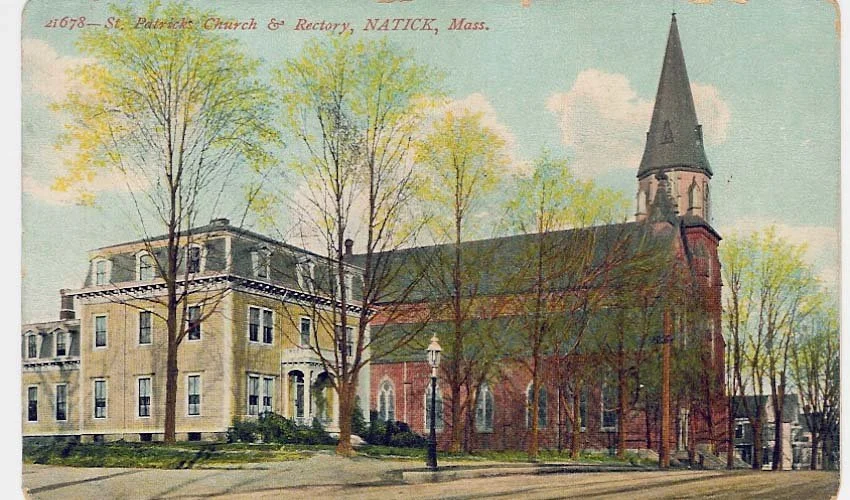
St. Patrick’s Church and Rectory, Natick, Mass., hand-colored postcard. NHS Collections.
The Building of St. Patrick’s Church in Natick
Researched by Cindy Tripp, written by Jennifer Richards.
The history of St. Patrick’s Church in Natick reflects the determination, faith, and generosity of a growing Catholic community in the nineteenth century. Archival records, newspaper accounts, and local histories together provide a rich picture of the church’s origins, construction, and the people who made it possible.
St. Patrick’s Parish was founded in 1856 by Father John Walsh, who became the first pastor of the Catholic community in Natick. At that time, Father Walsh purchased a church building from the Universalist Society on the site of what is now Natick Town Hall. That building served as the parish’s first house of worship and remained in use until plans could be made for a larger and more permanent church.
A major turning point came with the death of Father Walsh in 1890. He was succeeded by Father Delaney, who, at just thirty-nine years old, became the second pastor of St. Patrick’s Parish. Father Delaney immediately undertook the ambitious project of constructing the present church. Because the work depended heavily on fundraising and available resources, the building was completed in stages over the course of a decade.
The cornerstone of the new church was laid on May 29, 1892. Made of polished Quincy granite, it was a gift from John Whalen. A copper box was placed within the partially hollowed interior of the stone, creating a time capsule for future generations. Among the items placed inside were parish artifacts, current issues of the Boston Pilot and other newspapers, a roster of donors to the building fund, United States coins of every denomination, and an engraved plate commemorating the occasion. These objects symbolized both the hopes of the parish and its desire to preserve a record of its efforts.

St. Patrick’s Church, Natick, Mass., postcard published by Fairbanks & Son, Natick, Mass. NHS Collections.
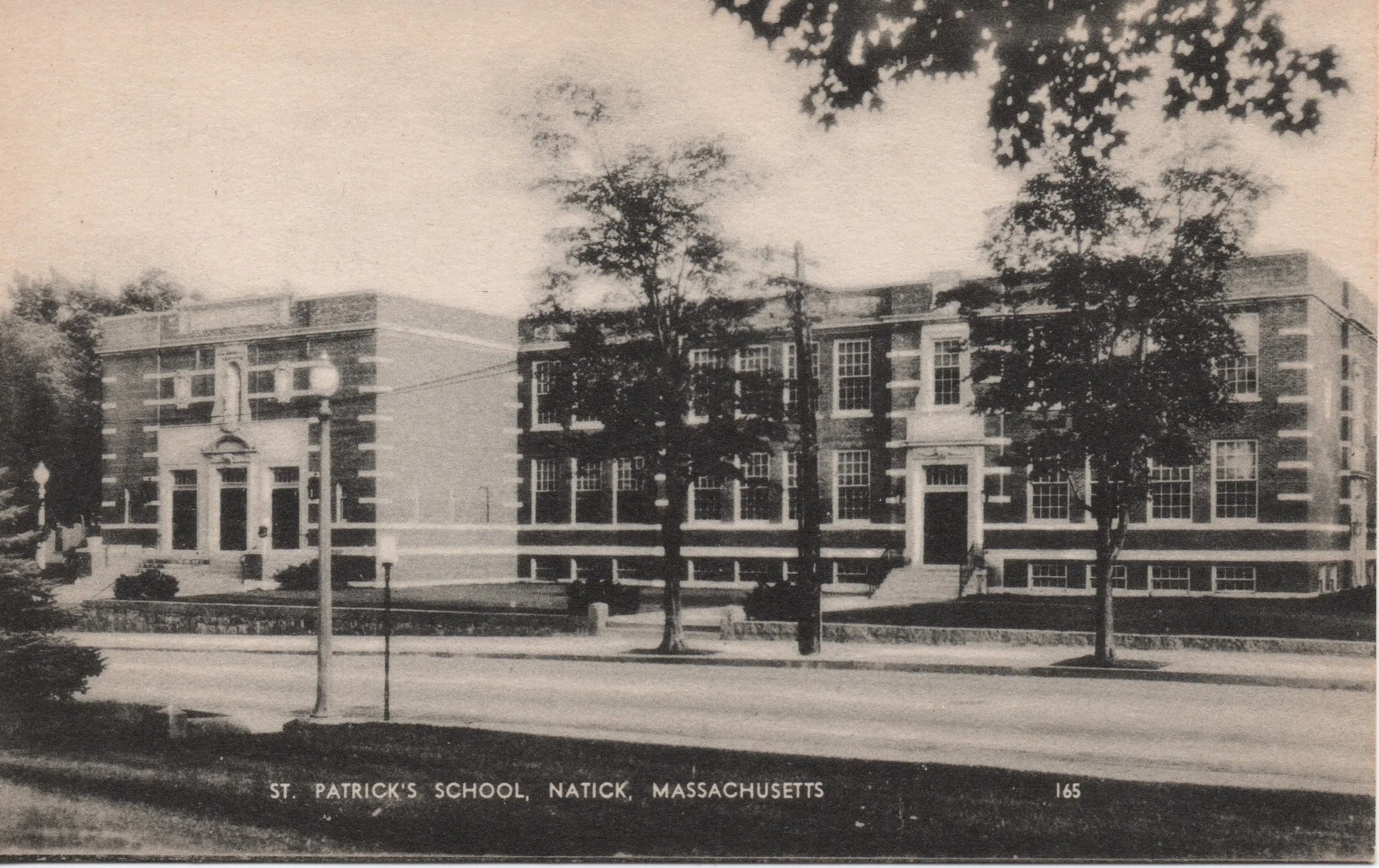
St. Patrick’s School, Natick, Massachusetts. Postcard. NHS Collection.
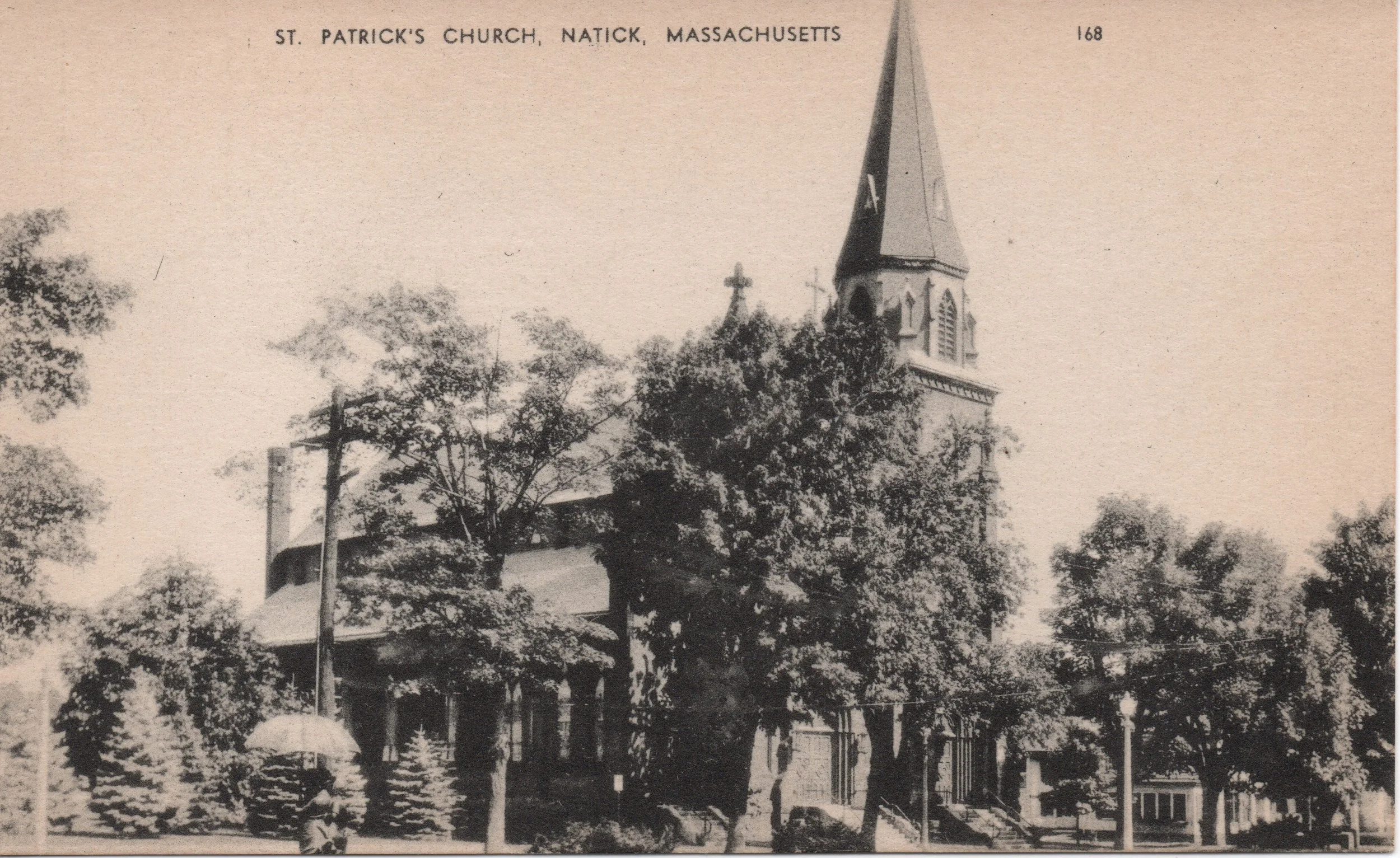
St. Patrick’s Church, Natick, Massachusetts. Postcard. NHS Collection.
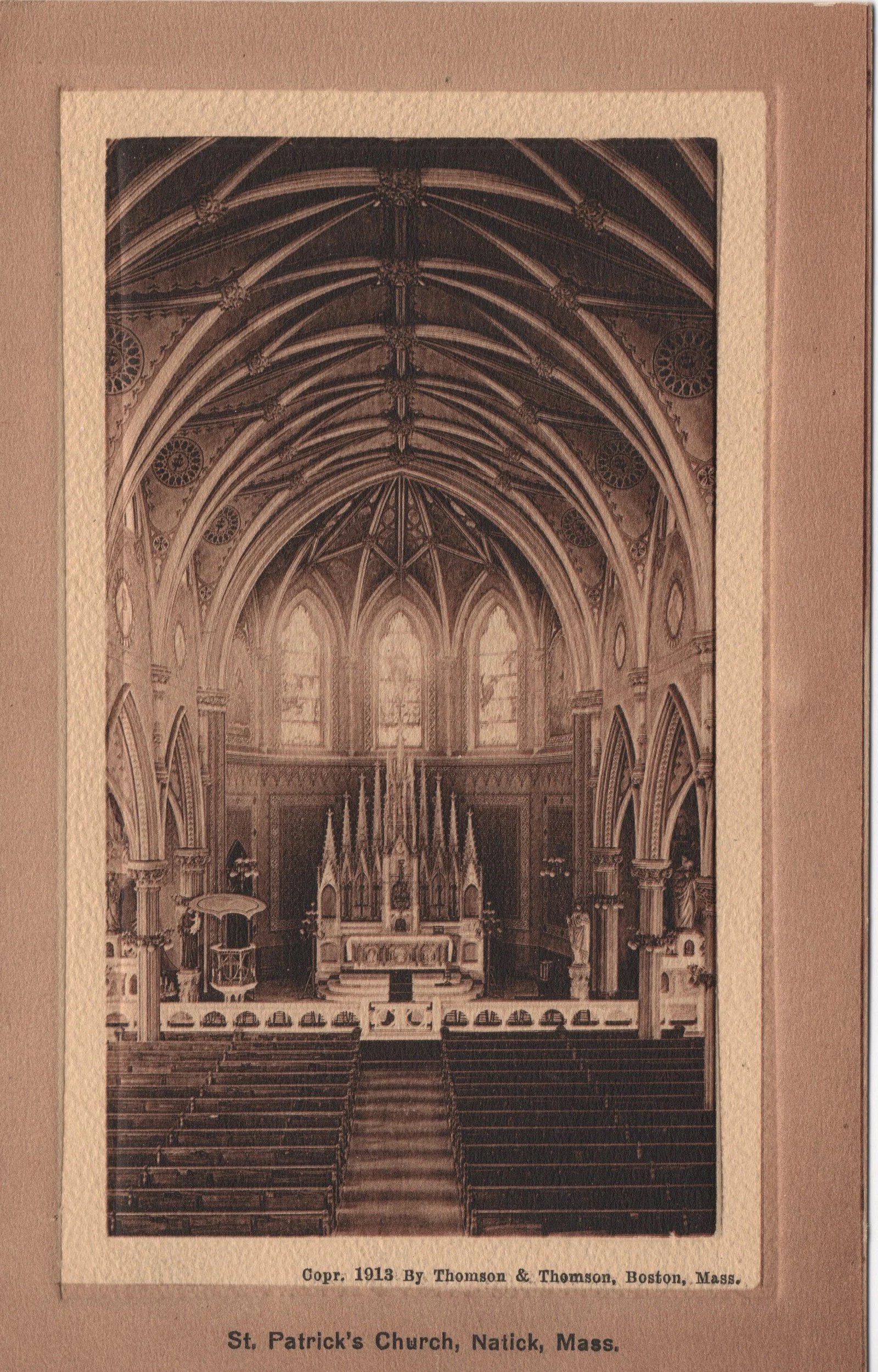
Interior of St. Patrick’s Church, Natick, Mass., postcard, copyright 1913 by Thomson & Thomson, Boston. NHS Collections.
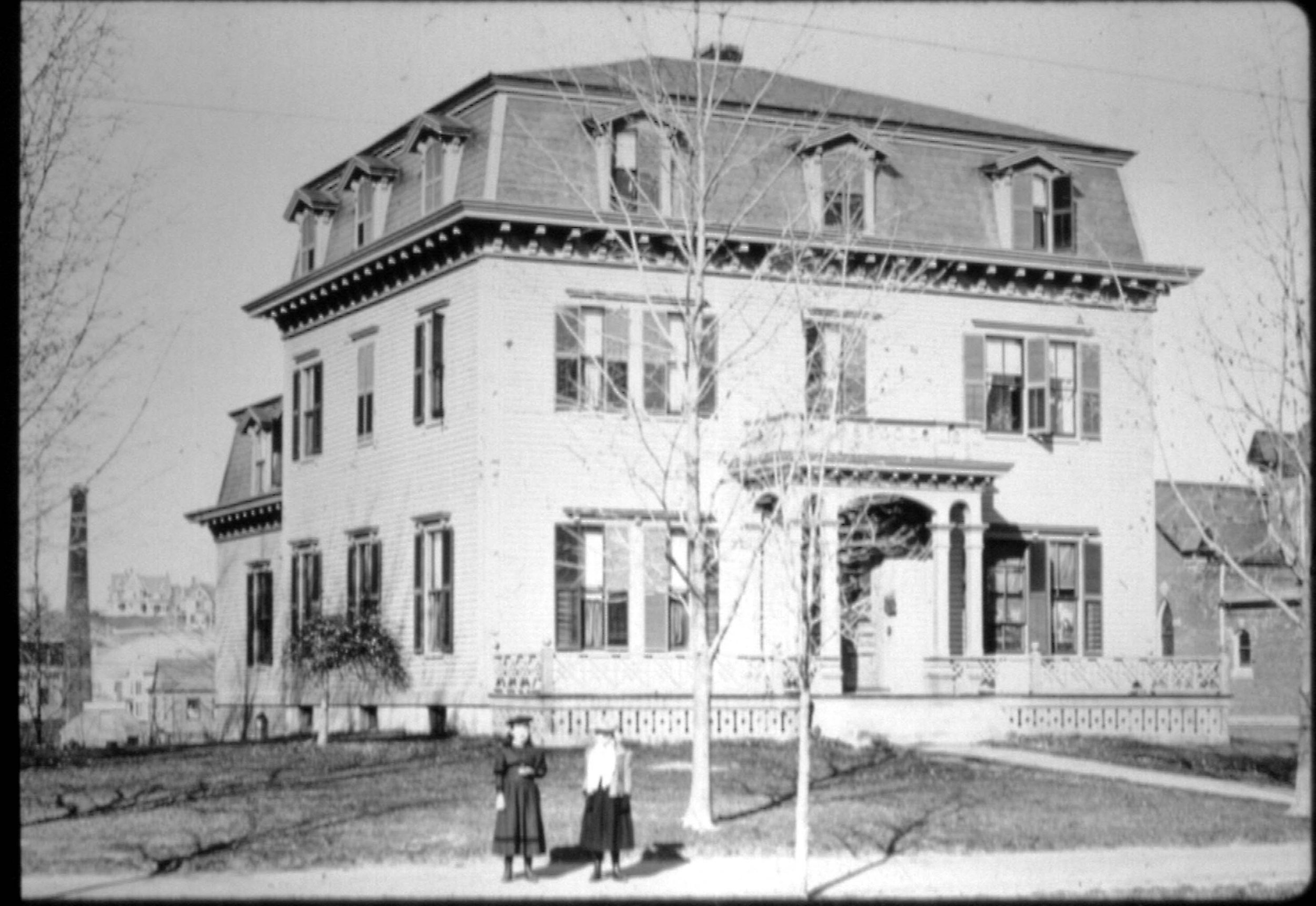
Catholic Parsonage, Natick, Massachusetts. Photograph. NHS Collection.
The project was supported by a building fund established specifically for the church’s construction. One of the most notable donors was John Everett, whose contribution of fifty dollars was the largest single gift recorded at the time. In recognition of his generosity, a solid silver trowel used during the laying of the cornerstone was presented to him. Everett was already a significant figure in the history of Natick’s Catholic community. An immigrant from Kilmacow, County Kilkenny, Ireland, he came to the United States in the 1840s and worked as a shoemaker in Cambridge, Medway, and Millis before settling in Natick in 1854. With a small group of fellow Catholics and under the leadership of Father Walsh, he helped found St. Patrick’s Parish in 1856. He also served the parish as sexton of the church and superintendent of St. Patrick’s Cemetery from before the Civil War. In time, Father Walsh encouraged Everett to establish a funeral business to meet the needs of the community, and John Everett & Sons was founded in 1861 at its present location across from Natick Common.
The architect chosen for the new church was James Murphy of Providence, Rhode Island, one of the leading ecclesiastical architects of his day. Murphy was born in County Tipperary, Ireland, in 1834 and immigrated to the United States as a young man. After arriving in Brooklyn, he apprenticed with Patrick Keely, another celebrated Irish-born church architect. Murphy later entered into partnership with Keely in the 1860s before establishing his own distinguished career. By 1876 he had been practicing architecture for twenty-four years, and in 1885 he was elevated to Fellowship in the American Institute of Architects. Though based in Providence, Murphy designed churches throughout New England, and his reputation was well established by the time he was commissioned for St. Patrick’s.
A local newspaper article from 1890 captured the excitement surrounding the project, reporting that “James Murphy, the celebrated ecclesiastical architect, was seen Thursday morning measuring the location to the east of the Catholic rectory. He pronounces it the most favorable location in town for a grand church edifice.” Two years later, another local article described the planned building in more detail. St. Patrick’s was to be constructed in the Gothic style, built of brick with Longmeadow rock-face trimmings and granite basement trim. It was designed to measure 152 feet in length and 71.6 feet in width, with a tower and spire rising 172 feet high. The church would have three entrances, and its chancel, formed as an apse, would be illuminated by five beautiful stained-glass windows. Those windows were supplied by the Mayer Company of New York and Munich, Germany, well known for their craftsmanship.
Financial realities, however, slowed the project considerably. By 1893 the basement level had been completed, but the money had run out before the upper church could be finished. Rather than leave the structure exposed, the unfinished building was roofed over, and the lower church was put into use. The first Mass was celebrated there on June 18, 1893. For the parish, this incomplete but usable space represented both an achievement and a promise of what was still to come.
As funds gradually became available, construction resumed. The work continued over the next several years until, on October 12, 1902, the upper church was finally completed and opened for full use. What had initially been projected to cost $60,000 ultimately required approximately $200,000 to finish, an illustration of both the scale of the undertaking and the persistence of the parish in seeing it through.
The history of St. Patrick’s Church is not only a story of architecture, but also of community effort. It is a story of immigrant faith, local generosity, and long-term commitment. From Father Walsh’s first parish church in 1856, to Father Delaney’s ambitious building campaign, to the contributions of men like John Everett and the work of architect James Murphy, the present church emerged through decades of vision and sacrifice. Even without original design plans, the surviving records allow us to see St. Patrick’s not simply as a building, but as a monument to the people who created it and the community it served.
Bibliography
“Among the Natick Churches: What the Religious Community Are Doing.”The Natick Bulletin (Natick, MA). May 2, 1890. Accessed April 3, 2026. https://morse.advantage-preservation.com/viewer/?i=f&by=1890&bdd=1890&d=01011890-12311890&e=james%20murphy&m=between&ord=e1&fn=the_natick_bulletin_usa_massachusetts_natick_18900328_english_1&df=1&dt=4&cid=3020
Canning Liturgical Arts. “James Murphy (1834–1907): Following in Patrick Keely’s Footsteps.” Accessed April 3, 2026. https://canningliturgicalarts.com/blog/james-murphy-1834-1907-following-in-patrick-keelys-footsteps/
John Everett & Sons Funeral Home at Natick Common. “About Us.” Accessed April 3, 2026. https://www.everettfuneral.com/about-us