
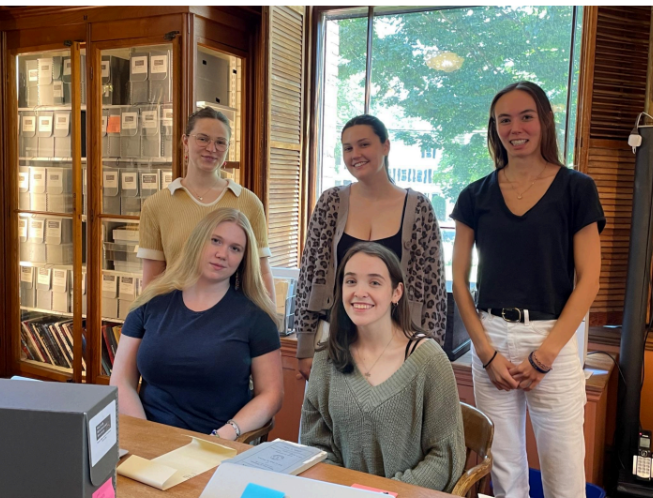
Thank you, Summer Interns!
It was a lively summer at the NHS! Seven summer interns worked together towards a shared goal: improving access to archival collections for everyone. Natick Historical Society Archivist, Jennifer Richards, reports that, “One of the most gratifying things was seeing how often one project led to another. Someone would open a folder, start processing a group of records, or begin researching an object, and suddenly we would find something completely unexpected to investigate — we call that a proverbial rabbit hole!”
Interns Kate Poe, Eve Callahan, and Emma Bartlett spent much of the summer processing unhoused and unsorted archival material. They worked through the Small Subject Archive and other groups of records, sorting and arranging material, checking PastPerfect for existing records, creating new catalog records, assigning numbers, uploading images, and rehousing material in appropriate archival folders and enclosures. They worked with correspondence, pamphlets, photographs, booklets, and ephemera. Some of this material had been sitting in boxes for quite some time, but over the course of the summer it was organized and clearly described; and today it is much easier to locate and use.
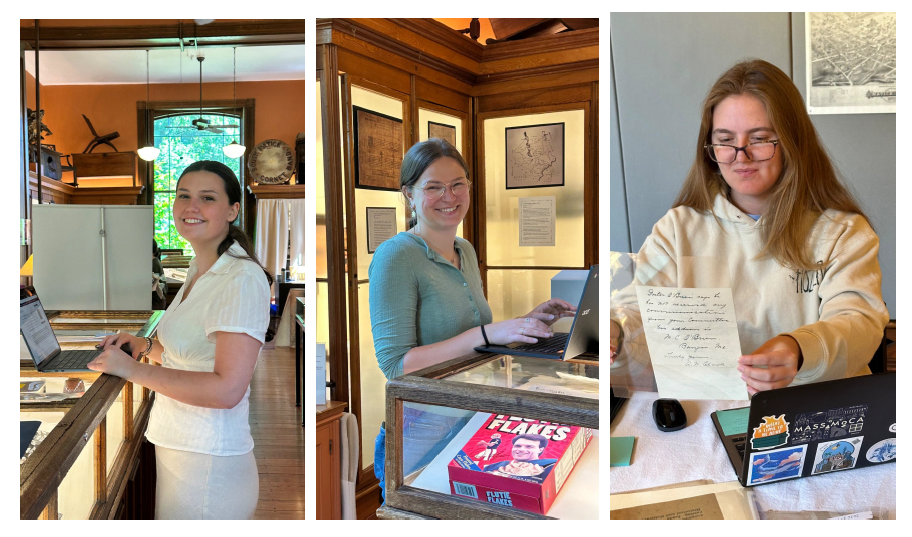
(Left to Right): Eve, Kate, and Emma, NHS summer interns, processing archival materials.
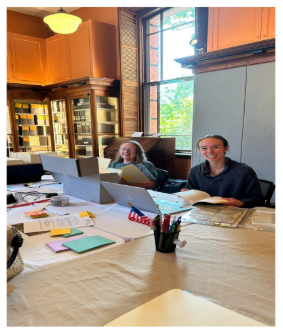
Anna Miksis works with longtime volunteer Sara Hana on the Natick Historical Society Land Deeds Collection.
Marg M. Balcom Memorial Archival Fellow Anna Miksis spent her fellowship immersed in the NHS land deed collection. She processed more than 125 deeds and created a corresponding detailed finding aid for the collection. Her work included: arranging and describing the deeds, identifying names, properties, roads, landmarks, and recurring families, and tracing relationships between individual documents. One especially interesting discovery involved a handwritten note about Pegan Hill that turned out to be a later annotation made by Samuel Bayard Stafford in 1881 on a very early deed. The project has transformed a large group of difficult-to-navigate documents into a much more accessible research collection. Anna returns to Simmons College this fall to complete her MLIS degree with a focus on archival work.
Interns Katie DiPalma and Reilly McKenna focused on research in addition to their collections work, responding to research requests and uncovering the history of artifacts. Reilly worked through objects stored on top of the museum cabinets, identifying them, checking for existing catalog records, creating or updating records where needed, and researching provenance and historical context. Katie cataloged photographs and answered a number of research requests. Together, they completed a deep dive into 35 Glenwood Street, using maps, censuses, newspapers, military records, directories, and other sources to trace the property and the people connected with it. In their hands, a question that began as a straight-forward house history, became a much more extensive report of the property and its occupants over more than a century.
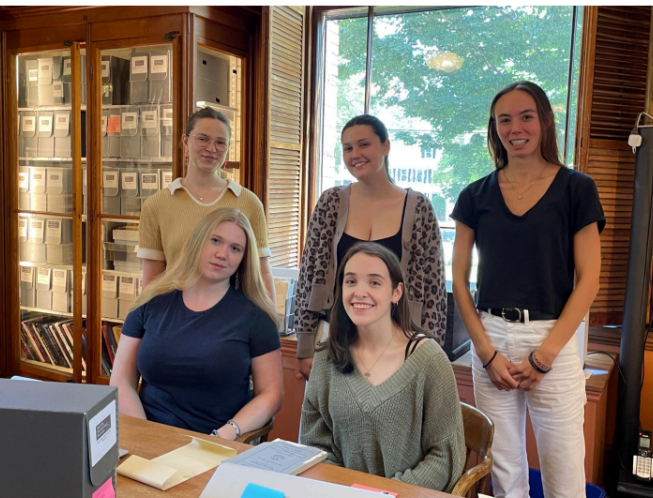
Summer Interns together at the Natick History Museum. Pictured are (back row, left to right) Kate Poe, Emma Callahan, and Anna Miksis, and (front row, left to right) Katie DiPalma and Reilly McKenna).
High School Student Summer Intern, Barbara, digitized and cataloged issues of the Natick Historical Society newsletter, The Arrow, creating digital surrogates that will make this material easier to preserve, search, and use. She also contributed to the research surrounding a remarkable 1649 document we recently uncovered in the collections. That discovery led to additional work identifying the document, understanding its relationship to a bill of exchange and protest, and researching the people and places connected with it in Boston and London. Finding a document from 1649 tucked away in another collection was certainly one of the more unexpected discoveries of the summer and a memorable experience for Barbara.
We are deeply appreciative of the contributions of our summer interns and equally so of the funds that help us support them: The Royal Little Family Foundation and the Marg M. Balcom Memorial Archival Fund. We wish all of our interns a wonderful fall semester and season!

Remembering Natick’s Suffragist, Olive Augusta Cheney (1833-1916)
Building Community by Inspiring Connections to Local History. Remembering Natick's Own Suffragist, Augusta Cheney - Natick Report. Natick boasts a rich, largely untold history of women who have significantly shaped our community and culture. Their narratives are invaluable, and we are committed to sharing them during Women's History Month and throughout the year.
For the complete article on Augusta Cheney, please refer to the article in the Natick Report available at https://www.natickreport.com/2025/03/remembering-naticks-own-suffragist-augusta-cheney/.
Additional information about Augusta Cheney can be found on our website at https://www.natickhistoricalsociety.org/augusta-cheney.

Natick’s Johnson Elementary School Collecting Memories
The Natick Report
January 19, 2024, by Bob Brown
With Johnson Elementary School ending its 75-year run at the end of this school year, memories of the Natick institution are being collected for posterity and to help celebrate its legacy.
The deadline for submitting stories, memories, and photos and participating in interviews has been extended to Jan. 31. If you have information or questions, contact Charleen Belcher (cbelcher@natickps.org), the librarian at Johnson Elementary School.
Information might be shared with the public in various ways, such as an online timeline and a display at the Morse Institute Library.
A brief history of Johnson can be found on the Natick Public Schools website.
There’s hope of a community celebration, most likely in June.

Join the Natick Historical Society to Celebrate 150 Years of Local History

This year marks the 150th anniversary of the Natick Historical Society, and the organization is ready to celebrate. The garden level of the Bacon Free Library in South Natick has been the historic home of the NHS since the building was completed in 1880 and has been renovated in exciting ways over the last five years.
“The light streaming in through our 12-foot windows brightens a refreshed museum space that is now ready for the community to connect over research, artifacts, and exhibits,” says NHS President Mike Pojman. “We look forward to welcoming the public back and gathering at the museum this spring.”
The NHS has evolved its mission since incorporation in 1873, but the core remains the same: to build community by inspiring connections to local history.
Executive Director Niki Lefebvre explains that “the founders of the NHS sought to bring remnants and relics of the world – past and present – to Natick. Today, our focus is right here in Natick. We believe that strong connections to local history build strong communities.” As she sees it, the early work of the NHS established a foundation for the organization’s mission today.
Lefebvre points out how vital the dedication of the NHS leadership and its many volunteers over time is to the work of the NHS today, especially regarding the collections. “Our collections include land documents, manuscripts, photographs, and artifacts that tell us about Natick across centuries. We have the vision of our founders and 150 years of committed volunteers to thank for that.” The museum reopens this April with items on exhibit ranging from Natick High School memorabilia to 18th-century land documents.
“We’re working hard today to make sure the NHS is well positioned to be a good steward of local history for another 150 years,” Lefebvre says. That work includes fundraising to ensure a solid financial footing, refining the collections, and, most importantly, developing relationships with Natick Nipmuc people and highlighting underrepresented voices from Natick’s past. “The time has long since come to tell stories about Natick that embrace this community in all its historical complexity. We owe that to all people who have called Natick home across the centuries, including those who lived here before the mission community was established in 1651.”
For more information on the Natick Historical Society and up-to-date plans for the April reopening events, follow them on Instagram (@natickhistoricalsociety) or sign up for the e-news at www.natickhistoricalsociety.org.

Rare Civil War-Era Artillery Shell Safely Defused in South Natick
Staff and volunteers uncovered a rare Civil War-era artillery shell of unknown provenance as part of a thorough collections inventory process at the Natick History Museum. On Monday, March 7, the artillery shell was x-rayed, safely detonated, and defused in nearby Hunnewell Field. The shell, tentatively identified as a Hotchkiss projectile, is now inert and has been returned to the museum. NHS President Mike Pojman told The Natick Report, “Now it’s perfectly safe… we’ll determine what to do with it. It would be wonderful to know if there’s some Natick connection.”
The Natick Historical Society would like to thank the Natick Police, Natick Fire Department, the State Fire Marshall, and the State Police Bomb Squad for the swift and safe management of the relic.
Read more from The Natick Report HERE.
Read more from The MetroWest Daily News HERE.