
Marion Louise Pooke: A Natick Daughter in War-Time Paris
Marion Pooke’s Service, Art, and Family Legacy
Marion Pooke’s Service with the American Expeditionary Forces
In November 1919—just months after returning from France—Natick’s Marion Louise Pooke addressed the Natick Woman’s Club with a talk titled With the A.E.F. in France. Drawing on her service with the American Expeditionary Forces at the end of World War I, she offered a vivid glimpse of wartime hardship, relief work, and the cautious hope that followed peace. But Marion was not only a war worker. She was also a trained artist whose life connected Natick to wider worlds of art, education, and international history.
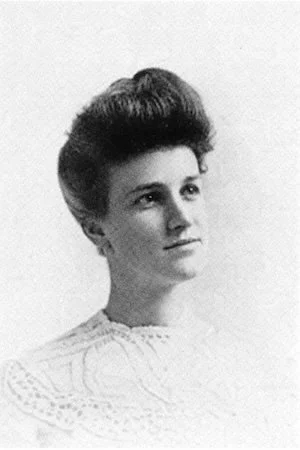
Marion Louise Pooke, Smith College yearbook portrait. Natick Historical Society Collections.
From Walnut Hill to the World Stage
Marion Louise Pooke (1883–1975) grew up in Natick, the youngest of three daughters of Charles Augustus Pooke (1855–1936), a partner in the Union Lumber Company and trustee of the Natick Trust Company, and Georgette Custer Pooke (1851–1918). She attended Walnut Hill School and graduated from Smith College in 1905.
Marion then pursued formal artistic training. She studied at the Massachusetts Normal Art School, where she received a teaching certificate in 1908, and from 1909 to 1913 continued her work at the School of the Museum of Fine Arts, Boston. By 1914, her progress was already attracting notice. A June 4 newspaper article, “Exhibit by Miss Marion L. Pooke,” praised her portrait work in a post-graduate studio at the Museum of Fine Arts and highlighted her sensitivity as a painter. Before the First World War reshaped her life, Marion was already emerging as a promising portrait artist. She later maintained studio space at both the Grundmann Studios and the Fenway Studios.
By her own account, Marion first viewed the war “in rather a detached way,” until a visiting speaker described the urgent need for Red Cross workers. She soon joined the American Red Cross and was later transferred to the Y.M.C.A., where her artistic training and teaching experience found unexpected purpose. After her mother’s death in 1918, Marion returned to Europe the following year to take part in wartime and postwar relief work.
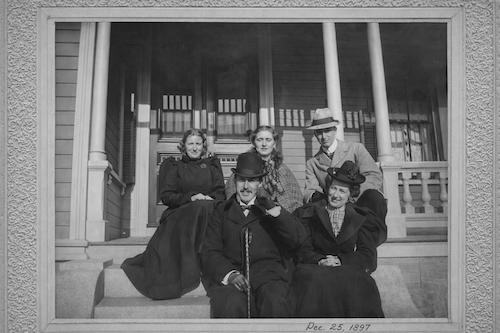
Pooke Family Group Portrait at 26 Winnemany Street, Christmas Day, 1897
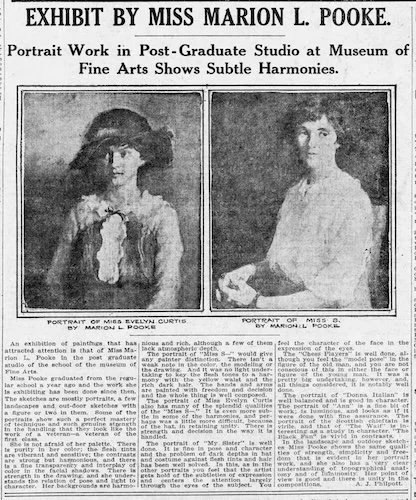
“Exhibit by Miss Marion L. Pooke,” The Boston Daily Globe (Boston, Mass.), June 4, 1914.
Art in the Shadow of War
Stationed in Paris, Marion served with the Educational Committee of the Y.M.C.A. There, she helped develop an extraordinary experiment: art studios inside military hospitals. In these makeshift classrooms, wounded and recovering soldiers were given the opportunity to draw, paint, and model clay—creative work that offered both expression and healing.
Men who had lost limbs or suffered shell shock found solace in sketching and sculpture. Skilled tradesmen worked beside trained draftsmen and architects, sharing techniques and encouragement. Hospital wards changed as soldiers pinned their drawings to the walls. Marion later wrote, “The men worked like dogs and excellent results were obtained… It was all a life saver and the men loved the studios.”
Exhibitions of patients’ work drew praise from visiting officers, and some examples were even sent to Washington, D.C., as evidence of how art could aid recovery. In Marion’s recollection, the studios did more than occupy time: they helped restore confidence, encourage discipline, and return a sense of purpose to men whose lives had been shattered by war.
Witness to History
Marion’s service placed her close to major events of the postwar world. In Brest, she caught sight of General John J. Pershing as troops and transports moved through the port. In Paris, she stood within view of President Woodrow Wilson during Memorial Day observances while the peace settlement was still being negotiated.
Most memorably, Marion was present at Versailles in June 1919 when the peace treaty was signed. She later recalled: “I was in Versailles on the day the Peace Treaty was signed… I shall never forget the jubilant throngs that filled Paris, waving flags, singing anthems, and parading captured cannon through the streets until dawn.” For Marion, the celebration of peace was inseparable from the memory of wounded soldiers and the immense work of rebuilding that still lay ahead.
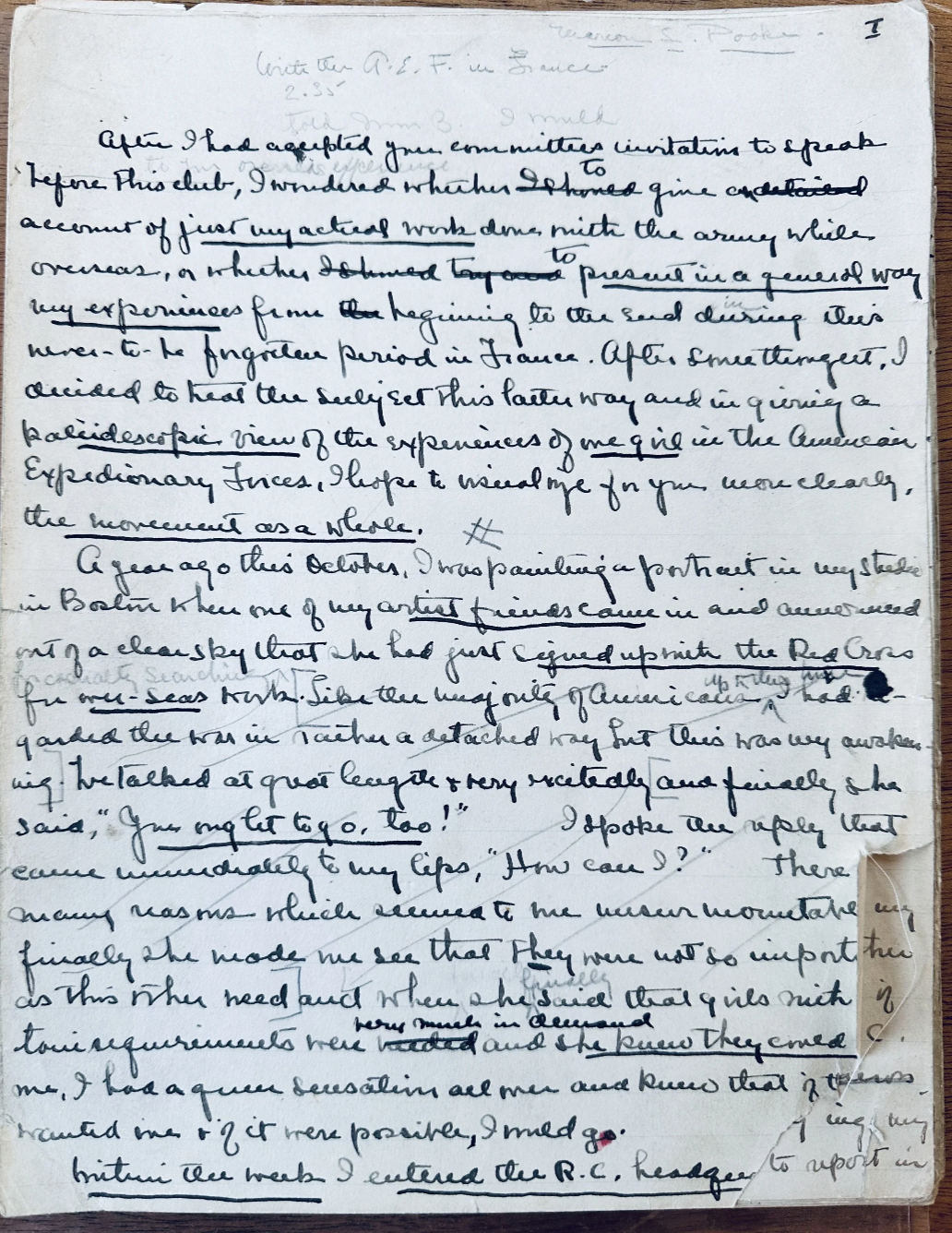
Manuscript Page 1, “With the A.E.F. in France,” by Marion Louise Pooke, Pooke Family Collection, Natick Historical Society.
Read the Full Manuscript
This manuscript of Marion Louise Pooke’s With the A.E.F. in France, presented to the Natick Woman’s Club in November 1919, provides a compelling first-person glimpse into her experiences in wartime France. Preserved in the Natick Historical Society's collections, the twelve-page typescript adds depth and immediacy to the story above. Link to PDF
Natick Connections Abroad
Even in wartime Paris, Marion found reminders of home. She wrote with delight of encountering Edna L. Hunnewell, “a Natick girl and a very dear friend of mine,” also serving under the Y.M.C.A. in Paris. The moment reveals how local ties can persist even amid a global conflict.
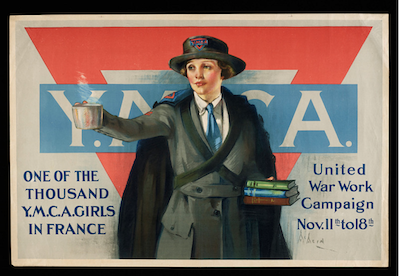
One of the Thousand Y.M.C.A. Girls in France. Courtesy of the Smithsonian Institution.
Hardship and Resilience
Marion’s work was physically and emotionally demanding. She crossed Paris on crowded trains and in hospital carriers, later recalling the rough rides over cobblestones with a sense of wonder at her own unexpected path through wartime France. “I would wonder how I of all people should be scurrying around Paris in this unconventional manner,” she wrote. “But I loved it all.”
Conditions were often difficult. She remembered long nights in unheated dormitories, bitter cold, and improvised living arrangements. At one point, a severe ear infection hospitalized her for weeks. Yet she continued to observe and admire the determination of the women around her and the courage of the soldiers they served.
Some of the deepest impressions came in the hospital wards. “We went into the first ward and I had my initiation into the real tragedies of the war… men without eyes, shell-shocked men, shrapnel wounded and gas-burned men without arms and legs.” These scenes stayed with her for the rest of her life.
Artist, Teacher, and a Life Beyond the War
Marion’s artistic career continued after her return from France. By 1926, her work was being exhibited at Walnut Hill School, where visitors were invited to meet her and view a group of paintings at the unveiling of her portrait of Miss Charlotte Howard Conant. The exhibition included about twenty works, among them a portrait of her father, Charles A. Pooke, and copies after European masterworks. Several paintings had been shown at major institutions, including the National Academy of Design, the Pennsylvania Academy of the Fine Arts, and the Art Institute of Chicago. One work, Silhouettes, had received a silver medal at the Panama Exposition.
These details show that Marion was recognized in her own time as a serious exhibiting artist with both local ties and a wider professional reputation. After her marriage to Bernard Duits, she settled in France, though her work and connections to Natick and Walnut Hill endured. Later sources remembered her as a gifted portrait painter whose work, once more widely known, was later rediscovered through renewed scholarly interest.
Works by and Attributed to Marion Louise Pooke
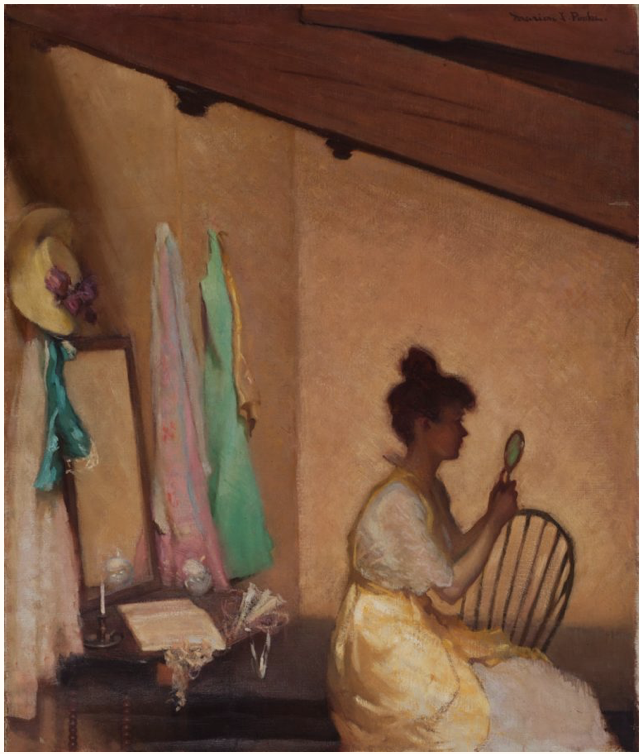
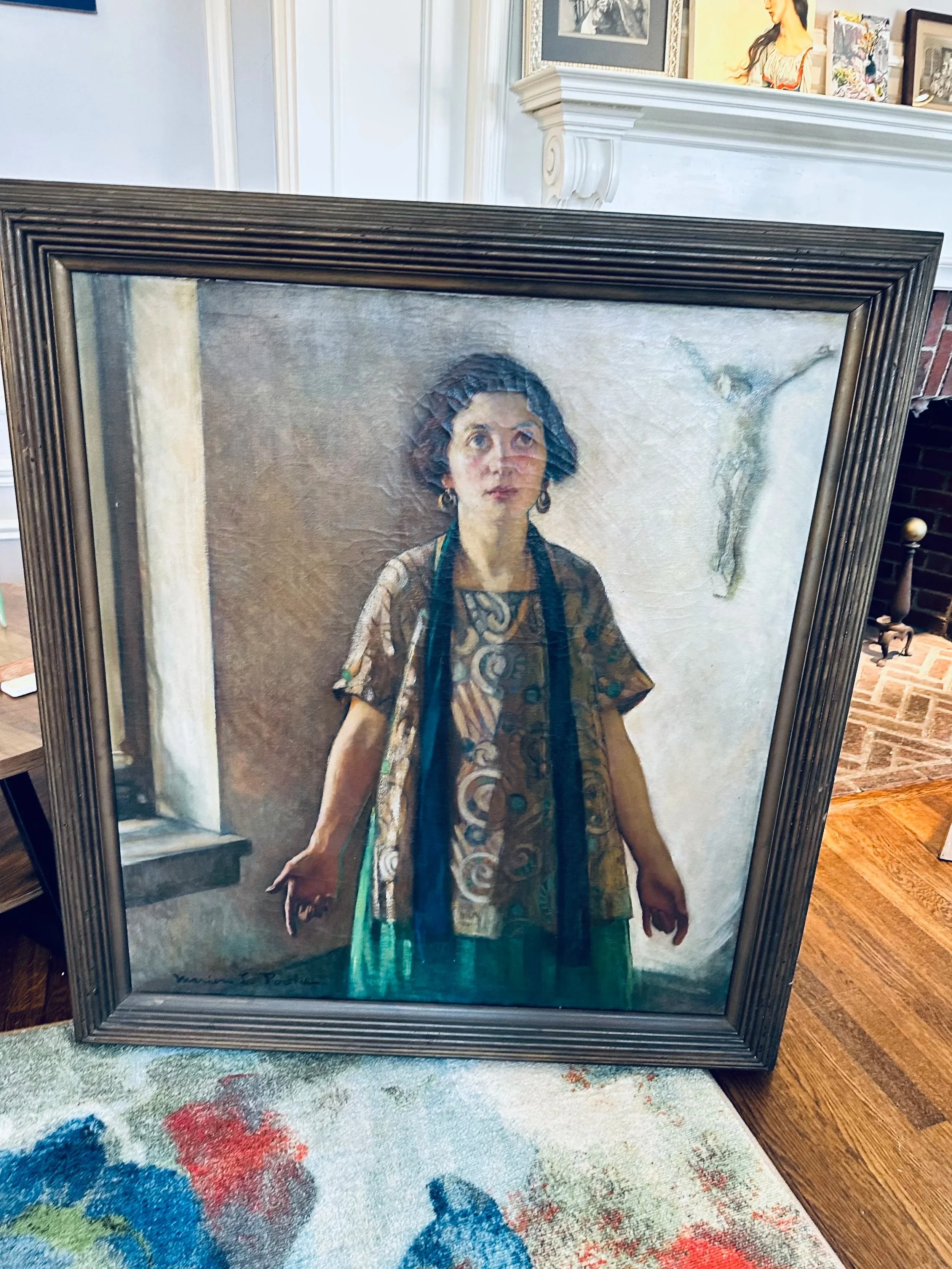
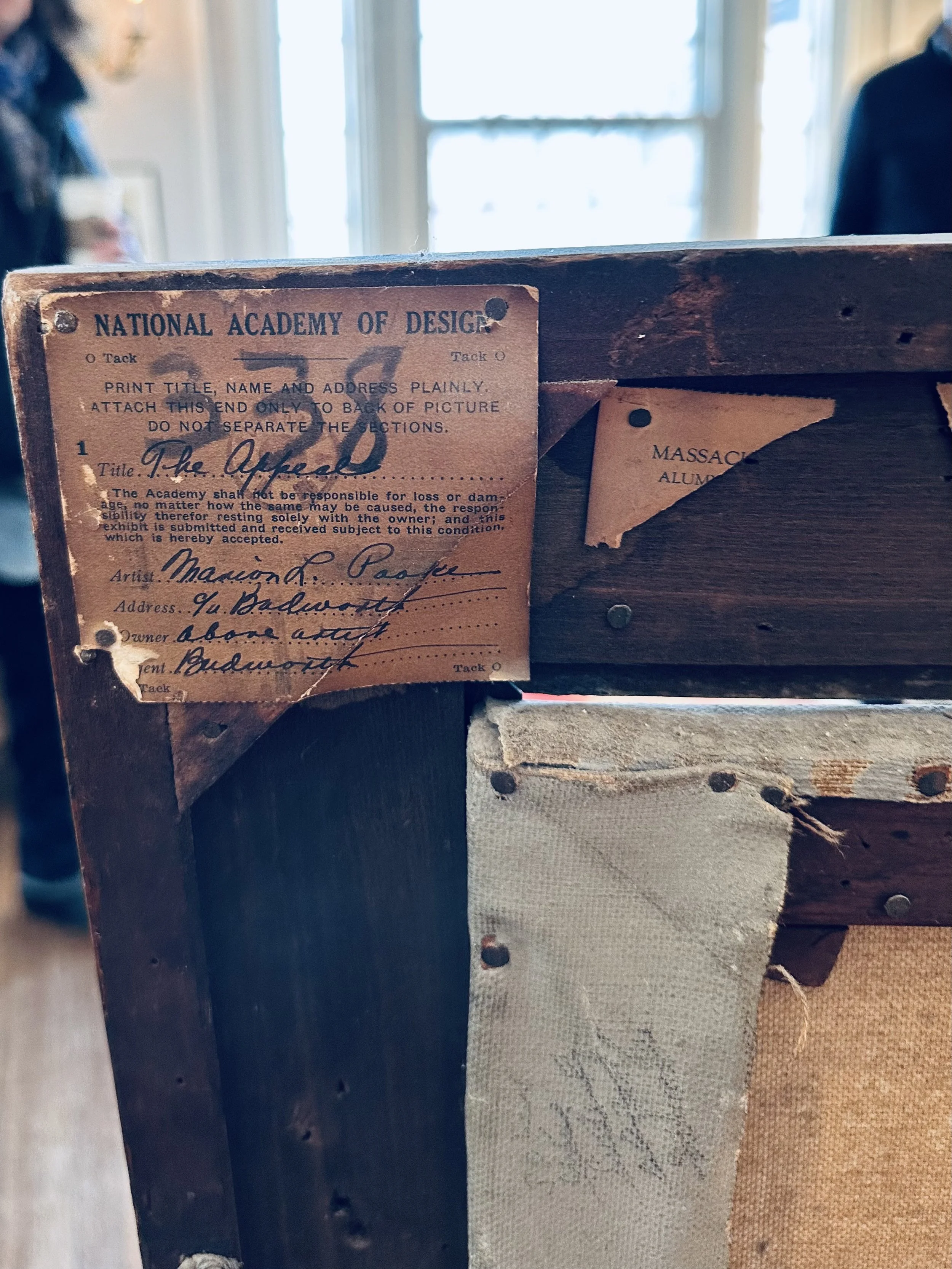
Written by Jennifer Richards, updated March 2026
Reading Marion Pooke’s lecture in its entirety is a fulfilling experience. Beyond the highlights and memorable quotes, her words carry the emotion and immediacy of someone who lived through extraordinary times and wanted her neighbors in Natick to understand them. The full document offers not just facts but a voice — candid, reflective, and at times humorous.
Sources & Additional Reading
Danforth Art Museum and Art School. “The One Night Stand.” Accessed March 13, 2026. https://danforth.framingham.edu/artwork/one-night-stand/.
Natick Historical Society. Pooke Family Materials, 1894–1964. Accession 2007:9. Finding aid. Natick Historical Society, Natick, MA.
Pooke, Marion Louise. With the A.E.F. in France (Lecture before the Natick Woman’s Club). November 1919. Manuscript, typescript, 12 pages. Natick Historical Society, Natick, Massachusetts.
Smith College Special Collections. “College Archives.” Accessed September 14, 2025. https://libraries.smith.edu/special-collections/college-archives.
Smithsonian Institution. “One of the Thousand Y.M.C.A. Girls in France.” Accessed March 13, 2026. https://www.si.edu/object/one-thousand-ymcagirls-france%3Anmah_1148108.
U.S. Army Center of Military History. Army Art in World War I: A Commemorative Print Set. Accessed September 27, 2025. https://history.army.mil/Publications/Publications-Catalog/Army-Art-in-World-War-I-A-Commemorative-Print-Set/.
Walnut Hill School for the Arts. Accessed October 29, 2025. https://www.walnuthillarts.org.